
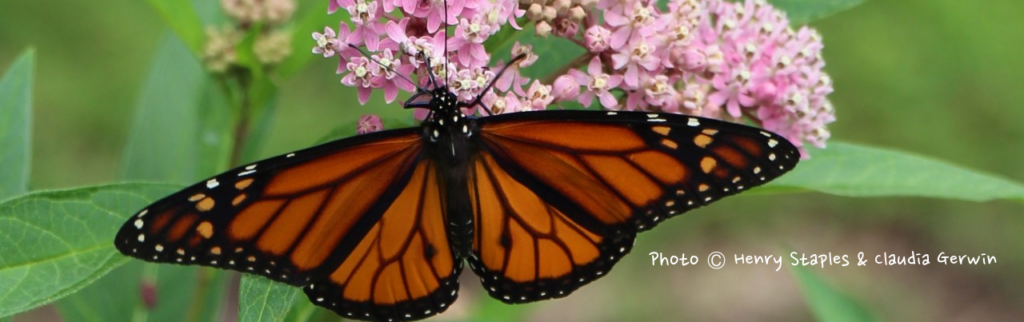
In recognition of International Pollinator Week in mid-June, join Extension Master Gardener Elaine Mills to discuss the small animals that perform such an important role in our home landscapes. Learn about the characteristics of our pollinators and the plants native to the Mid-Atlantic region that will attract them and fill their needs, whether your garden space is large or limited to a patio or balcony. Special attention will be given to keystone plants, soft landings plantings beneath trees, and the needs of pollen specialist bees.
Zoom session, recorded June 5, 2026
Partnering With Pollinators Supporting Material
Pollinators | Native Plants That Support Pollinators | Best Gardening Practices For Pollinators | Resources
Note: Most of the links in the first two sections go to MGNV Tried & True Fact Sheets for the Mid-Atlantic.
Fact sheets with accompanying videos of pollinators are marked with a star (★)
🐛 = Larval host plant & number of Lepidoptera supported
🐝 = Plant supporting pollen specialist bees
Pollinators
Beetles
Prefer open white, cream, or green-colored flowers with fruity or fetid fragrance
- Sweetbay Magnolia (Magnolia virginiana)
- Sweet-shrub (Calycanthus floridus)
- Skunk Cabbage (Symplocarpus foetidus)
Butterflies
Prefer flat, composite flowers in bright colors
- Purple Coneflower (Echinacea purpurea) ★
- New York Ironweed (Vernonia noveboracensis)
- Purple Joe-pye-weed (Eutrochium purpureum)
Moths
Prefer pale or white, night-scented tubular flowers
- Garden Phlox (Phlox paniculata)
- Evening Primrose (Oenothera biennis)
- Common Yucca (Yucca filamentosa)
Wasps
Prefer white or yellow flowers with shallow corollas
Syrphid, Bee, Tachinid, House Flies
Prefer shallow white or yellow flowers
- Common Yarrow (Achillea millefolium)
- Black-eyed Susan (Rudbeckia hirta)
- Sneezeweed (Helenium autumnale)
Carrion Flies
Prefer dark brown, purple, or pale flowers
Bees
Prefer blue or purple tubular flowers (white/yellow secondary)
- Anise Hyssop (Agastache foeniculum) ★
- Rough-stemmed Goldenrod (Solidago rugosa) ★
- Nodding Onion (Allium cernuum)
Hummingbirds
Prefer bright-colored tubular flowers
Native Plants That Support Pollinators
Most supportive keystone plant genus
- White Oak (Quercus alba) 🐛 500+
Early Spring Ephemerals
- Bloodroot (Sanguinaria canadensis)
- Spring Beauty (Claytonia virginica)
- Dutchman’s Breeches (Dicentra cucullaria)
Early Spring Trees
- Red Maple (Acer rubrum) 🐛 297
- Downy Serviceberry (Amelanchier arborea) 🐛124
- Eastern Redbud (Cercis canadensis) 🐛19
More Spring Trees
- Black Cherry (Prunus serotina) 🐛 456
- Black Willow (Salix nigra) 🐛 455
- River Birch (Betula nigra) 🐛 413
Spring Herbaceous Plants
More Spring Blooms
- Large-flowered Bellwort (Uvularia grandiflora)
- Blue-eyed Grass (Sisyrinchium angustifolium)
- Golden Alexanders (Zizia aurea)
- Wild Columbine (Aquilegia canadensis) 🐛 37
- Robin’s Plantain (Erigeron pulchellus) 🐛20 🐝 12
- Blue Wild Indigo (Baptisia australis) ★ 🐛 20
Later Spring Blooms
Spring-blooming Shrubs
- Highbush Blueberry (Vaccinium corymbosum) 🐛 294 🐝 14
- Carolina Rose (Rosa carolina) 🐛 135
- Hazelnut (Corylus americana) 🐛132
More Spring-blooming Shrubs
- Black Haw (Viburnum prunifolium) 🐛104
- Pinxterbloom Azalea (Rhododendron periclymenoides) 🐛 51
- Black Chokeberry (Aronia melanocarpa) 🐛 29
Early Summer Blooms
Summer-blooming Shrubs
Mid-Summer Blooms
- Coastal Plain Joe-pye-weed (Eutrochium dubium) ★ 🐛 42
- Swamp Milkweed (Asclepias incarnata) ★ 🐛 12
- Blue Vervain (Verbena hastata) ★ 🐛 11
- Garden Phlox (Phlox paniculata) 🐛 8
- Great Blue Lobelia (Lobelia siphilitica) 🐛 4
- Blazing Star (Liatris spicata)
- Oxeye (Heliopsis helianthoides)
- Turk’s Cap Lily (Lilium superbum)
- Orange Coneflower (Rudbeckia fulgida) ★ 🐝 29
Late Summer Blooms
- Threadleaf Coreopsis (Coreopsis verticillata)
- Short-toothed Mountain-Mint (Pycnanthemum muticum) ★
- New York Ironweed (Vernonia noveboracensis) 🐝 12
More Summer-blooming Shrubs & Vine
- Shrubby St. John’s-wort (Hypericum prolificum)
- Sweet Pepperbush (Clethra alnifolia) 🐛 10
- Trumpet Honeysuckle (Lonicera sempervirens) ★ 🐛 37
Top Fall Perennials
- Blue-stemmed Goldenrod (Solidago caesia) 🐛 115 🐝 42
- Aromatic Aster (Symphyotrichum oblongifolium) 🐛 112 🐝33
- Woodland Sunflower (Helianthus divaricatus) 🐛 73 🐝 50
More Fall Blooms
- Wingstem (Verbesina alternifolia) 🐝 17
- Field Thistle (Cirsium discolor) 🐝 15
- Little Bluestem (Schizachyrium scoparium) 🐛 6
Soft Landings Plants Beneath Keystone Trees & Shrubs
- Green-and-Gold (Chrysogonum virginianum)
- White Wood Aster (Eurybia divaricata)
- Hairy Alumroot (Heuchera villosa)
- Golden Ragwort (Packera aurea)
- Pennsylvania Sedge (Carex pensylvanica)
- Bottlebrush Grass (Elymus hystrix)
- Marginal Wood Fern (Dryopteris marginalis)
- Christmas Fern (Polystichum acrostichoides)
Best Gardening Practices For Pollinators
Plant Selection
- Select plants native to the region
- Use a mix of woody and herbaceous plants with nectar and pollen (especially for pollen specialist bees)
- Include keystone larval host plants for caterpillars
- Include soft landings plants beneath keystone trees
- Provide a continuous succession of flowering plants from spring through fall
- Aim to have three species blooming at one time
- Be careful of cultivars, especially those with changes in color, shape, or double-flower forms
- Avoid Butterfly Bush & Tropical Milkweed which do not support full life cycle of butterflies
- Remove/do not buy invasive plants
Garden Design
- Reduce lawns as appropriate and replace them with forage plants
- Plant pollinator beds in an open, sunny location
- Plant in masses and drifts to create better visual attraction and facilitate efficient foraging
- Work to connect existing native plant community fragments and corridors
Habitat
- Leave areas of bare soil for ground-nesting bees
- Retain 12-24 inches of cut stems for cavity-nesters
- Bundle any broken stems in a protected area for nesting
- Be aware of issues of safety and health with bee hotels
- Retain leaf litter for overwintering insects and delay clean-up in spring to allow insects to emerge
- Leave dead trees (snags) and logs as nesting sites
- Provide containers with water and landing spots for pollinators
- Leave puddling areas for Lepidoptera to access minerals and salts
- Use shielded, downward-facing lights with yellow or amber-colored LED bulbs to protect moths
Avoid the use of pesticides & herbicides
- Beneficial insects are affected as well as targeted species
- Buy from nurseries that do not use systemic insecticides
- Strive for non-chemical methods to control pests (including mosquito spray)
- Employ cultural practices to maintain the health of plants
- Restrict rare but necessary use to times when forage plants are not flowering
Resources
Pollinators
- Attracting Native Pollinators, Xerces Society
- Pollinator Victory Garden, Kim Eierman
- Pollinators of Native Plants, Heather Holm
- Pollinators (Short videos on MGNV YouTube Channel)
Beetles
- Beetle Pollination, Forest Service, USDA
- Beetles as Pollinators, Xerces Society
- Welcoming Fireflies & Other Creatures to Your Yard, MGNV video
Butterflies & Moths
- Butterflies & Moths (Life Cycle & Survival Tactics), MGNV
- Gardening to Attract Butterflies & Moths, MGNV
- Welcoming Beautiful Butterflies, Moths & Skippers, MGNV video
- Butterflies of Northern Virginia Index, PWC Alliance
- Butterflies, Moths, & Skippers (State listings and photos)
- Butterfly Gardening, Jane Hurwitz
- Caterpillars of Eastern North America, David L. Wagner
- Moths of the World, David L. Wagner
- Northern Virginia Butterflies and Skippers, Robert R. Blakney
Wasps
- Wasps: Beneficial Insects and Pollinators of Native Plants, Heather Holm
- Wasp fact sheets & regional native plant lists, Heather Holm
Flies
- Flower Flies, US Forest Service
Bees
- Bee Basics, An Introduction to Our Native Bees, USDA Forest Service & Pollinator Partnership
- Bees, Identification & Native Plant Forage Guide, Heather Holm
- Pollen Specialist Bees of the Eastern United States, Jarrod Fowler & Sam Droege
- U.S. Geological Survey Bee Inventory (Incredible photos)
Native Plants
- Tried and True Native Plant Selections for the Mid-Atlantic, MGNV
- Best Bets to Attract Pollinators, MGNV (fact sheet)
- Mid-Atlantic Pollinator Plant List, LB Johnson Wildflower Center
- Pollinator Plants, Mid-Atlantic Region, Xerces Society
Keystone Plants
- Keystone Plants for the Home Landscape, MGNV video
- Nectar & Host Plants for Selected Butterflies & Moths, MGNV
- Native Caterpillars & Moths and Host Native Woodies, Wild Ones
- Soft Landings Add Life Under Native Trees, Izel Native Plants
Invasive Plants
- Are “Sterile” Butterfly Bush Cultivars Environmentally Safer?, MGNV
- Invasive Butterfly Bush & Native Alternatives, MGNV
- Tropical Milkweed – A No-Grow, Xerces Society
Best Practices for Pollinators
- Building and Managing Bee Hotels for Wild Bees, MSU Extension
- Creating Inviting Habitats, Virginia Tech Online Publications
- How to Create Habitat for Stem-nesting Bees, Heather Holm
Garden Plans
- Pollinator Garden Plan, MGNV
- Small Space Garden Plan, MGNV
- Hedgerow for Sun, Pollinator Pathway
- Native Pollinator Garden Recipe Cards, Pollinator Partnership
- Native Pollinator Garden Templates, Howard County, MD
- Pollinator Garden for Sun, Plant NoVA Natives
- Pollinator Gardens Design Guide, USDA
Container Gardening with Native Plants
- Container Gardening with Native Plants, MGNV (video)
- Nine Native Perennials to Brighten Your Balcony, MGNV
- Container Gardening for Earth Renewal, Plant NoVA Natives
- Container Gardening with Native Plants, Missouri Botanical Garden
- North American Keystone Plants (Container-friendly), Homegrown National Park
- Wildlife Waystations: Captivating Containers with Native Plants, NoVA Bird Alliance